The post Pennsbury High School Project Faces DEP Scrutiny Over Wetlands Concerns first appeared on Pennsbury411.
]]>The Complaint That Triggered DEP Action
Community oversight played a pivotal role in this inspection. Robert Abrams, a Pennsbury resident, filed a formal complaint with DEP to ensure the district’s construction plans received proper environmental review. His concerns centered on whether the site contained wetlands and whether fill had already been placed in areas that should have been protected. News of the DEP visit was first revealed at Pennsbury’s Act 34 Hearing held on September 4, 2025.
DEP inspectors visited the site on August 28, 2025, and documented hydric soils, surface water, and fill material in suspected wetland areas. They also noted drainage infrastructure and soil samples consistent with wetland indicators. While no explicit violation was issued on the spot, DEP requested a formal wetland delineation before construction could proceed. This step is critical: under Pennsylvania’s Chapter 105 regulations, any encroachment on wetlands requires permits, mitigation, and strict erosion controls. Abrams’ complaint ensured that the district cannot bypass this process.
Wetlands and Hydric Soil: A Foundation Problem
The inspection report highlights the presence of hydric soils—a hallmark of wetlands. Hydric soils are saturated or flooded long enough to create anaerobic conditions, making them unsuitable for conventional construction foundations.
For a project of this scale—nearly half a million square feet across three stories—the risks are magnified:
- Structural instability: Hydric soils can shift, compress, or lose bearing capacity, undermining the stability of a large building.
- Drainage complications: Surface water and poor percolation increase the risk of flooding and long-term water damage.
- Regulatory exposure: Building on wetlands without proper permits can trigger enforcement actions, fines, and even orders to restore impacted areas.
Pennsbury’s plan to use a floating slab foundation adds another layer of complexity. While floating slabs are sometimes used on unstable soils, they are not a cure-all. On hydric soils, slabs can crack, tilt, or fail if water levels fluctuate or if fill material was improperly placed. For a three-story educational facility, the margin for error is slim.
The Scale of the Project Meets Environmental Reality
The proposed Pennsbury High School is not a modest addition—it is a 495,000-square-foot, three-story building intended to consolidate and modernize the district’s facilities. Such a project requires not only architectural vision but also geotechnical certainty.
Building on hydric soils raises several pressing issues:
- Load-bearing capacity: A structure of this size exerts enormous pressure on the ground. Without engineered stabilization, hydric soils cannot reliably support the weight.
- Long-term maintenance costs: Even if construction proceeds, ongoing settlement and water intrusion could lead to costly repairs, undermining taxpayer investment.
- Environmental impact: Wetlands serve as natural flood buffers and habitats. Filling or altering them can disrupt ecosystems and increase flood risks for surrounding neighborhoods.
The DEP’s insistence on delineation is not a bureaucratic delay—it is a safeguard against environmental damage and structural failure.
What Compliance Will Require
To move forward, Pennsbury School District must take several concrete steps:
- Commission a wetland delineation study: A qualified consultant must map and classify the wetlands on site. This will determine the extent of regulatory oversight.
- Secure Chapter 105 permits: If wetlands are confirmed, the district must apply for permits to impact them, including mitigation plans such as creating or restoring wetlands elsewhere.
- Reassess foundation design: Engineers must evaluate whether a floating slab is viable on hydric soils or whether alternative foundation systems (such as deep piles or soil stabilization) are required.
- Implement erosion and sediment controls: Construction near wetlands demands strict runoff management to prevent downstream impacts.
These steps are not optional. Without them, DEP could halt construction, impose penalties, or require costly remediation.
Conclusion: A Path Forward for Pennsbury
The DEP inspection, prompted by Robert Abrams’ complaint, has placed Pennsbury’s high school project under a necessary spotlight. The discovery of hydric soils and potential wetlands means the district cannot simply proceed with its ambitious 495,000-square-foot, three-story building on a floating slab foundation without addressing environmental and engineering realities.
To come into compliance, Pennsbury must conduct a full wetland delineation, secure permits, and reassess its foundation strategy. Only by aligning its construction plans with environmental regulations and soil science can the district ensure that its new high school is both legally sound and structurally safe.
The lesson here is clear: large-scale development requires not just vision, but vigilance. By respecting wetlands and addressing hydric soil challenges head-on, Pennsbury can build a school that stands the test of time—without compromising the environment or community trust.
The post Pennsbury High School Project Faces DEP Scrutiny Over Wetlands Concerns first appeared on Pennsbury411.
]]>The post Pennsbury’s Audit: Better Late Than Never? first appeared on Pennsbury411.
]]>Pennsbury, for its part, did push to get the work finished albeit softly, but the report still landed in November — just in time for Thanksgiving, when most taxpayers are more focused on stuffing turkeys than digesting balance sheets. Because nothing says “timely financial oversight” like serving up last year’s numbers as leftovers at the holiday table. Transparency delivered, but only after a marathon delay that makes even cold cranberry sauce look fresh.
The Good
Despite the tardiness, the audit does contain some bright spots.
First, the District’s General Fund balance increased by $1.17M, ending at $20.43M. That’s a healthy cushion, representing 7.93% of the 2024–25 expenditure budget — just under the state’s 8% cap. Importantly, the District didn’t need to dip into reserves to balance the budget, meaning revenues covered expenditures. In the world of school finance, that’s a win.
Second, the District’s overall net position improved by $13M. Governmental activities gained $12.96M, while business-type activities (like food services) added $52K. Even though the District remains in deficit, this marks progress. Pension liabilities also ticked down slightly, easing long-term obligations.
Finally, the auditors issued an unmodified opinion — the gold standard in audit language. No material weaknesses, no compliance violations. For taxpayers, that means the numbers are reliable, even if they’re not pretty.
The Bad
The bad news is that Pennsbury’s balance sheet still looks like a cautionary tale.
The District’s net position remains deeply negative at $(297M). Liabilities and deferred inflows outweigh assets and deferred outflows by a staggering margin. While the $13M improvement is welcome, it’s like patching a pothole on a collapsing bridge.
Liquidity is another sore spot. Current assets fell by 32%, dropping from $111.5M in 2023 to $75.8M in 2024. Much of this decline reflects capital spending, but it leaves the District cash-light and vulnerable to unexpected shocks.
The Capital Projects Fund also took a beating, dropping by $37M due to planned construction. That left only $605K restricted for future projects. In other words, the District spent heavily on facilities but now has little left in reserve for the next round of capital needs.
The Ugly
The truly ugly part of the audit is the structural burden of debt and pensions.
General obligation debt stands at $177.6M, while the actuarially determined net pension liability is $305.8M. Together, they account for over 86% of total liabilities. These obligations aren’t going away — they will continue to weigh down the District for decades.
The unrestricted net position deficit is $268M. That’s the portion of the balance sheet not tied to capital assets or restricted funds. In plain English: the District owes far more than it owns, and the gap is widening.
Even with operational surpluses, the District is structurally underwater. The audit confirms what many already suspected: Pennsbury is managing the short term reasonably well, but the long-term picture is grim.
The New Pennsbury HS Impact
Now let’s layer in the school district’s Taj Mahal project for which an Act 34 Hearing was recently held: a brand-new high school, financed with $270M in new debt. What will this new luxurious building mean for taxpayers?
Debt Service
At 4% interest over 30 years, annual payments would be about $15.6M. Over the life of the bonds, total payments would reach $468M, including nearly $198M in interest. But let’s be honest — 4% is an unlikely rate in the current lending environment but the foundation metric the district and its financial advisors have utilized in estimates. With municipal borrowing costs elevated, Pennsbury will almost certainly face rates closer to 5% which could be refinance downward at a later date.
At 5%, the math gets uglier: annual payments climb to roughly $18.2M, and total payments balloon to about $546M. That’s nearly $266M in interest alone, meaning taxpayers would spend almost as much on financing costs as on the high school itself. The difference between 4% and 5% is not just a rounding error — it’s an extra $78M burden over 30 years, spread across the community.
Taxpayer Impact
Pennsbury has roughly 25,000 taxable parcels to our best knowledge. Divide the $15.6M annual debt service by 25,000 parcels, and each parcel would need to contribute about $624 per year. That’s on top of existing taxes and increases being placed upon resident for actual daily school operational costs.
Expressed as a percentage, $15.6M equals 6.1% of the General Fund budget. So taxpayers would face an effective 6% annual tax increase to sustain the new debt while maintaining the 7.93% reserve ratio. Over three decades, the cumulative burden per parcel would be about $18,720. For the community as a whole, the total tax contribution would be $468M.
The Bottom Line
A new high school would certainly be a landmark investment, but it comes with a heavy price tag. The average homeowner would pay an extra $624 annually for 30 years, nearly $19,000 in total. For a District already carrying massive pension and debt obligations, this project risks pushing Pennsbury from “structurally challenged” to “financially precarious.”
The challenge isn’t just the annual tax bill — it’s the way the balance sheet would tilt. Adding roughly $270M in new debt would nearly double Pennsbury’s general obligation liabilities, pushing total long‑term debt well past $450M. When combined with the existing $305M pension liability, the District’s obligations would exceed $750M. Even though the new high school would appear as a capital asset on the books, the asset‑to‑liability ratio would deteriorate sharply: liabilities would balloon far faster than assets, leaving the District even deeper in negative net position.
In practical terms, Pennsbury’s already weak asset coverage — just $214M in assets against $559M in liabilities — would worsen. With the new debt, assets might rise to around $494M (reflecting the new building), but liabilities would surge to nearly $839M. That means for every dollar of assets, the District would carry about $1.70 in liabilities, compared to $1.30 today. It’s a structural imbalance that no amount of short‑term operating surplus can mask, and it underscores how the high school project would shift Pennsbury’s financial posture from strained to outright leveraged.
Closing Thoughts
The audit may have arrived late, but its message is clear: Pennsbury is balancing today’s books while mortgaging tomorrow’s future. Adding $270M in new debt for a high school would shift the burden squarely onto taxpayers, who would be paying for decades. The question isn’t whether the District can build it — it’s whether the community can afford to live with the bill. This become especially concerning as township and county tax rate increase are also expected to rise significantly. As previously reported here at PSD411, over 4% of Falls Township residents were delinquent in their school tax payment, which equates to 1 in 25 families at risk of losing their homes for failure to pay taxes.
While the audit confirms Pennsbury’s short-term operational stability, it also reinforces the long-term structural challenges that credit agencies like Moody’s monitor closely. The District’s persistent net position deficit, heavy pension obligations, and declining liquidity are all red flags in the eyes of bond analysts. Although the unmodified audit opinion and reserve compliance are positives, the overall financial posture remains fragile. If Pennsbury proceeds with a $270M high school project without a clear revenue offset, Moody’s could interpret the move as a credit-negative event — potentially triggering a rating downgrade or outlook revision. That would raise future borrowing costs and signal to investors that the District’s fiscal flexibility is narrowing. In short, the audit doesn’t just reflect the past — it sets the tone for how Pennsbury will be judged going forward.
The post Pennsbury’s Audit: Better Late Than Never? first appeared on Pennsbury411.
]]>The post Over 4% of Falls Residents Behind On School Tax Payments first appeared on Pennsbury411.
]]>
RTKs Confirm Falls Residents Are Hurting
On August 18, 2025, Pennsbury resident Robert Abrams filed a Right-to-Know request seeking information on school tax delinquencies, citing concerns raised during committee sessions and prior School Board Action Meetings. Community frustration has been mounting, with residents voicing alarm during public comment periods and across social media—particularly in response to news about the new Pennsbury High School building. Many argue that tax hikes are spiraling out of control and far outpacing local wage growth. Nevertheless, at its June 2025 meeting, the District approved the maximum tax increase permitted under Act 1.
Abrams RTK Request asked for the following data:
1. Listing and all available information (parcel number, owner, address, amount in arrears etc.) for all Pennsbury School District resident properties moved to Sheriff’s Sale due to non-payment of School Taxes between the dates of July 1, 2023 and inclusive to August 17, 2025.
2. Listing and all available information (parcel number, owner, address, amount in arrears etc.) for all Pennsbury School District resident properties currently in arrears for non-payment of school taxes not as yet foreclosed on or sent for Sheriff’s Sale as of August 17, 2025.
As reflected in the request, Abrams sought the information before additional delinquencies would have been recorded due to non-payment in September 2025. The metadata from the exported file indicates that the data was generated on September 21, 2025. Full details of Abrams’ submission are publicly accessible via the Pennsbury transparency portal: https://pennsburyschooldistrictpa.nextrequest.com/requests/25-99
What Does Pennsbury’s Response Reveal?
Documents released by the Pennsbury School District reveal that 480 properties are currently delinquent in their school tax payments. Of those, 12 are in active proceedings for seizure or sale by the Bucks County Sheriff’s Department. Notably, 413 of the delinquent properties—representing a staggering 84%—are located in Falls Township. By contrast, Falls Township accounts for roughly 45% of Pennsbury’s total taxable parcels, according to prior Right To Know records..
PSD411 reached out to Falls Township Tax Collector Kim Scarpiello, who recently spoke at Pennsbury’s Act 34 Hearing. In her remarks, Scarpiello urged the District to reconsider its approach to the new high school project, citing firsthand experience with residents struggling to meet their tax obligations. She confirmed that Falls Township has 10,033 taxable parcels contributing to school taxes. Based on the data, approximately 4.12% of property owners in Falls are behind on payments—placing them at risk of losing their homes if they cannot catch up. Put plainly: one in every 25 property owners in Falls Township is delinquent. That means someone on your street may be facing the threat of foreclosure due to unpaid school taxes..
Below is a copy of the records obtained by PSD411. To show respect for the privacy of affected homeowners, all personally identifiable information has been redacted. The data shown reflects only the amounts of outstanding taxes owed to Pennsbury.
A Tipping Point for Pennsbury: When Tax Policy Threatens Community Stability
The data is no longer abstract—it’s personal. With one in every 25 Falls Township property owners now delinquent on school tax payments, the consequences of unchecked tax increases are playing out in real time. These aren’t speculative fears or partisan talking points; they’re lived realities for families facing foreclosure, retirees on fixed incomes, and working-class residents whose wages haven’t kept pace with Pennsbury’s fiscal demands.
The compounding effect of annual maximum tax hikes—layered atop a looming 100%+ township tax increase for Falls Township residents to offset the landfill’s closure—creates a financial squeeze that many households simply cannot absorb. When tax policy outpaces wage growth, it ceases to be a tool for public investment and becomes a mechanism of displacement. If current trends continue, Pennsbury risks hollowing out its own tax base, destabilizing neighborhoods and eroding the very community it seeks to serve.
This is no longer a debate about school buildings or budget line items—it’s a reckoning with the human cost of fiscal decisions. The question now is whether leadership will acknowledge the warning signs and recalibrate, or whether residents will be left to bear the burden alone.
The post Over 4% of Falls Residents Behind On School Tax Payments first appeared on Pennsbury411.
]]>The post Pennsbury’s Act 34 Hearing Reveals Deep Community Divide first appeared on Pennsbury411.
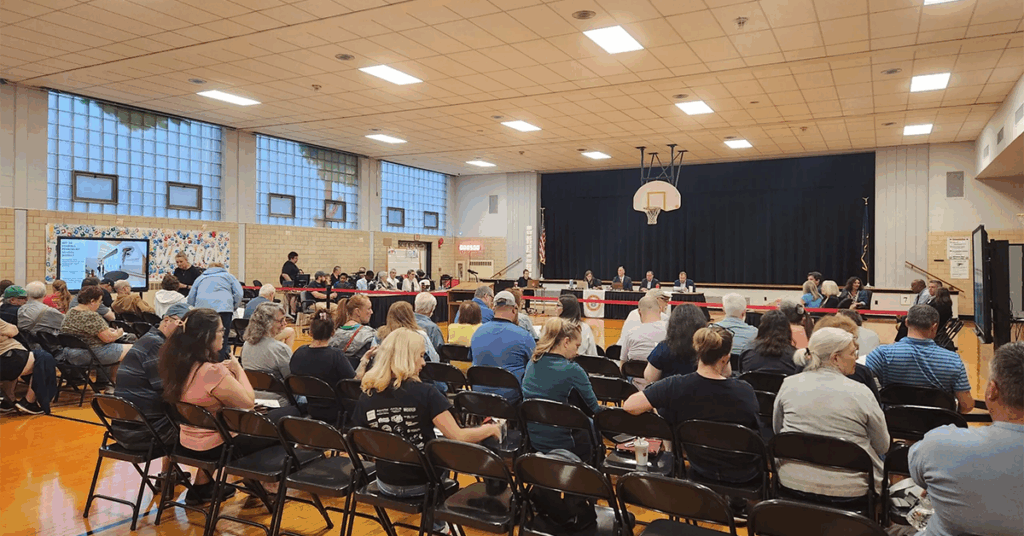
]]>On September 5, 2025, the Pennsbury School District hosted a state-mandated Act 34 hearing at Fallsington Elementary School to present and solicit public feedback on its proposed $269.5 million high school construction project. The Act 34 hearing, required under Pennsylvania law for major school building initiatives, drew over 100 residents despite competing with the Philadelphia Eagles’ home opener—a testament to the intensity of local interest and concern. For those that did attend, many were unimpressed by the limited details put forward by Pennsbury and its vendors that last approximately 15 minutes
The Proposal: Scope and Cost
The district’s plan calls for a 497,000-square-foot facility to replace the aging Pennsbury East and West campuses, which date back to the 1960s. The new building would be constructed on the south side of the current campus along Hood Boulevard, with the existing structures slated for demolition upon completion.
The total estimated cost detailed in the Act 34 Hearing booklet includes $212.4 million for construction, $33 million for site development, and $1.3 million in architectural fees. Financial adviser Zach Williard of PFM noted that Pennsbury’s strong Aa3 credit rating would allow it to issue bonds without insurance, potentially minimizing the tax impact. However, the projected millage increase of 14.6 mills left many residents uneasy.
Supporters: Safety, Modernization, and Educational Value
Proponents of the project—largely parents and younger families—argued that Pennsbury students deserve a modern, consolidated facility that meets current safety and accessibility standards. Superintendent Dr. Thomas Smith emphasized that the split-campus model forces students to walk between buildings, compromising instructional time and security. He also cited the lack of natural light and ADA compliance in the existing structures.
School board candidate Jim Boice, an employee of the New Jersey Education Association (NJEA) teacher’s union, offered a glowing endorsement of the project, declaring, “The students are the heart of our district… We want our kids going to top-quality buildings, so they feel good about themselves.” But for many attendees, Boice’s remarks landed with the subtlety of a campaign flyer. His enthusiasm seemed less rooted in fiscal scrutiny than in personal excitement that his young son would be among the first to benefit from the new facilities.
Architect Michael Strohecker addressed design concerns, confirming the inclusion of both sex-specific and gender-neutral restrooms.
Critics: Tax Burden, Transparency, and Site Concerns
Opposition came primarily from senior citizens and longtime residents worried about affordability and transparency. Falls Township Tax Collector Kim Scarpiello warned that the tax hike could “shove [seniors] out of homes.” Juliana Winberg highlighted income disparities in Falls Township, noting that while the median household income is $86,000, the per capita income drops to $37,000 when retirees and unemployed residents are included.
Critics also questioned the district’s financial projections. Robert Abrams and Tim Daly, both Lower Makefield residents, pointed to cost overruns in past projects—like the stadium renovation ballooning from $4.1 million to $21 million—and raised concerns about the feasibility of staying within the approved budget. Abrams cited a former business manager’s estimate of $368 million, which would have triggered a voter referendum under Act 34.
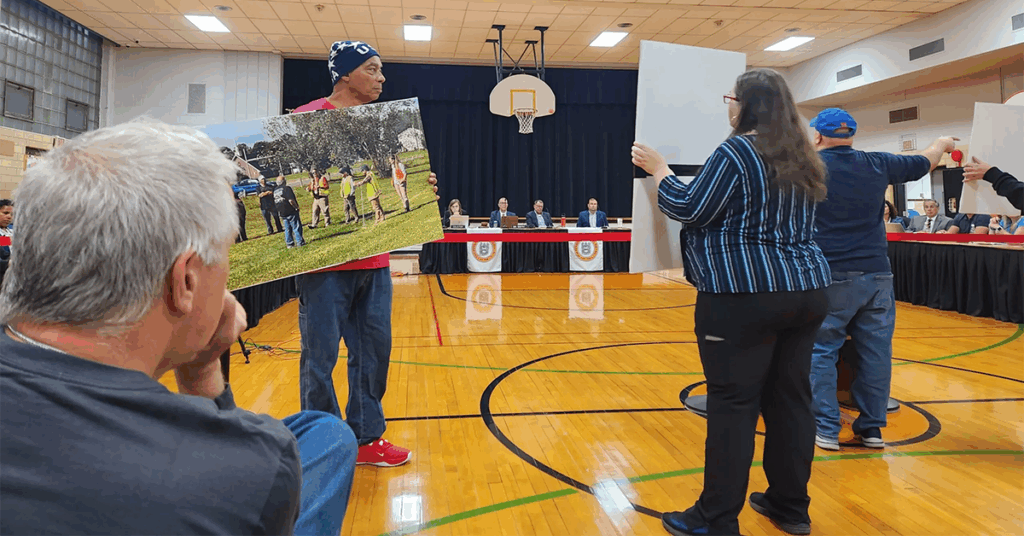
Site conditions added another layer of controversy. Daly and Abrams presented photos of puddles and sinkholes, even in dry weather, suggesting underground water issues. They urged the Pennsylvania Department of Environmental Protection (DEP) to investigate. While Pennsbury officials insisted the site had been vetted and DEP review is routine, residents remained skeptical.
Andrew Dell, a candidate for the Pennsbury School Board, also voiced strong opposition to the project. He criticized the district’s lack of transparency and questioned the financial prudence of moving forward without a voter referendum. Dell’s remarks echoed broader concerns about the district’s communication and accountability, positioning him as a vocal advocate for fiscal restraint and public oversight. “Everyone is going to have to sell their house because they’re not going to be able to pay their taxes here,” Dell expressed during his remarks, arguing that the cost estimate was unrealistically low.
Referendum Debate and Next Steps
One of the most contentious questions was whether the project should be subject to a public referendum. Currently, the district’s approved cost falls below the threshold that would require one. However, if bids exceed $217.1 million for building construction, either a second Act 34 Hearing will be required or a referendum would be mandated by the PA Department of Education.
The district plans to solicit bids this fall, and the outcome will determine whether a second hearing or referendum is necessary. Written comments from residents are being accepted until October 6, 2025, and can be submitted to the district’s Chief Financial Officer—though the position remains vacant following CFO Chris Berdnik’s recent departure.
Conclusion: A Community at a Crossroads
The Act 34 hearing laid bare the deep divisions within the Pennsbury community. Supporters see the new high school as a long-overdue investment in education and safety. Opponents fear financial overreach, displacement, and lack of transparency. With the bidding process looming and DEP review pending, the district faces a critical juncture—one that may ultimately require voters to decide.
References From Local News Organizations
Delaware Valley Journal: Pennsbury’s $269M High School Plan Faces Cheers, Jeers at Public Hearing
Bucks County Herald: Hearing on new Pennsbury High School shows a split community
LevittownNow.com: Residents Speak Out At Pennsbury Hearing On New High School
The post Pennsbury’s Act 34 Hearing Reveals Deep Community Divide first appeared on Pennsbury411.
]]>The post Pennsbury Act 34 Hearing Scheduled September 4th first appeared on Pennsbury411.
]]>The hearing will take place on September 4, 2025 at Fallsington Elementary at 7pm…coincidentally scheduled during the Philadelphia Eagles opening game of the NFL season. For those unable to attend, note that written testimony is given the same weight by the Pennsylvania Department of Education as oral public comment. Written testimony can be mailed to the following address:
Thomas A. Smith, Ed. D., Superintendent
Pennsbury School District
134 Yardley Avenue
Fallsington, PA 19054
This blog recommends that anyone providing written testimony also be sent digital to [email protected] to ensure your remarks aren’t “lost in the mail” or “mishandled” by the Pennsbury Administration staff. All email communications received by the Pennsbury are required by law to be saved for a minimum of two year.

What Is Act 34 And How Does It Protect The Community?
Act 34 of 1973, also known as the “Taj Mahal Act,” mandates that public hearings be held for significant construction projects involving new school buildings or substantial additions to existing buildings. This applies when floor space increases by 20% or more. The act requires school districts to justify the need for these projects, provide descriptions, disclose maximum costs, and outline financing plans and tax impacts.
Act 34 prioritizes transparency and public input by ensuring that communities are informed and involved in the decision-making process. Public hearings allow citizens to review and discuss proposed projects, with documentation like floor plans made available for at least 30 days. This ensures that the community can voice concerns, suggest alternatives, and hold school boards accountable for their decisions.
By requiring thorough public scrutiny and a potential referendum if project costs exceed certain limits, Act 34 aims to protect the financial interests of residents. It helps prevent exorbitant spending on school construction without adequate justification and citizen approval. This process ensures that taxpayer money is spent wisely and that new construction projects genuinely meet the community’s needs.
Why Is District Saying They Need a New High School?
The current campus—comprised of Pennsbury East, Pennsbury West, and the Natatorium—is fragmented, outdated, and non-compliant with ADA standards. Students must traverse nearly 1,800 feet between buildings, often outdoors, creating safety and accessibility concerns. Classrooms lack natural light, are undersized, and do not support modern teaching methods. The Natatorium’s six-lane pool is insufficient for hosting competitive events, and infrastructure across all buildings is inefficient and costly to maintain
What’s Being Proposed?
The district plans to construct a 497,000-square-foot, three-story high school on the existing site. Key features include:
- A secured main entrance with administrative offices
- A 1,000-seat auditorium and black box theater
- A centralized “Pennsbury Path” for safe student circulation
- A learning courtyard for natural light and outdoor instruction
- Athletic facilities including a 3,000-seat gym, 8-lane pool, and multiple auxiliary spaces
- Flexible classrooms and small-group learning areas to support evolving curriculum models
Upon completion, the existing buildings—including Village Park Elementary—will be demolished to streamline the site layout and improve safety. The Pennsbury School District gave limited to no consideration for alternative options such as a Renovation/Expansion of PHS West which would cost $80M+ less than a new build despite the building core being renovated in 2005 at a cost of $45M. Financials of the district detail persistent re-financing off debts, suggesting no principal has ever been paid down on the previous PHS West renovation.
Financials & Tax Impact
The total project cost for the new Pennsbury High School is estimated at $269,546,944, with a maximum building construction cost of $212,409,380 as defined under Act 34. This figure represents the district’s declared construction ceiling for the school building itself, excluding ancillary costs like site work, furnishings, and financing.
Under Act 34, if the actual building construction cost exceeds $217,119,048, the district would be legally required to hold a voter referendum before proceeding. This threshold is known as the aggregate building expenditure standard, and it functions as a safeguard to ensure public oversight if costs escalate beyond the approved scope. If quotes received exceed the estimated building construction costs by $4,709,668, either a referendum will be required or Pennsbury can make alterations to its plans and initiate a second Act 34 Hearing.
Separately, Act 1 imposes a debt capacity limit. As confirmed by the Bucks County Herald, the Pennsbury School District has stated that the total project cost cannot exceed $304 million, which is the district’s maximum allowable debt capacity under Act 1. This cap includes all financing, contingencies, and non-construction expenses.
To fund the project, the district plans to issue general obligation bonds, with total principal and interest payments projected to reach $569.4 million, paid off by the early 2060s. The estimated millage impact is 14.60 mills, and the district anticipates no increase in operational costs due to efficiencies gained from the new building’s design. Details of Pennsbury’s financial condition will be presented by PFM Financial Advisors, LLC, the same organization that was responsible for the financial forecasts that came under fire in public meetings for numerous mathematical errors during the failed Pennsbury – Morrisville Merger Feasibility Study that was halted in June 2023.
What Lies Beneath?
As Pennsbury School District advances its plan to build a new consolidated high school, the environmental assessments tied to the main construction site may warrant closer scrutiny. While the District performed geological and wetlands studies, the summaries provided offer limited insight into the scope, methodology, or long-term implications of those findings per the Act 34 Hearing Packet. With nearly 500,000 square feet of new construction planned, it is critical that these concerns are resolved before groundbreaking to avoid costly change orders for unforeseen developments
PSD411 has previously alerted the community of environmental concerns posed identified thought RTKs submitted by the District. The following are some of our previous posts regarding the land under consideration for the construction build:
- Pennsbury Initiating Wetlands Assessment On Proposed New HS Grounds (March 30, 2025)
- Lack Of Transparency Continues On Pennsbury High School Building Project (May 2, 2025)
- PHS Building Project Geotechnical Report Filled With Holes, Raising Concerns (May 15, 2025)
- Pennsbury High School Project Hits Speed Bump (August 11, 2025)
In a project of this magnitude, environmental due diligence should be more than a checkbox. The community deserves access to all the detailed reports and a clear plan for monitoring, accountability, and remediation. Until those details are made public, the environmental integrity of the Pennsbury High School project remains an open question.
Read The Act 34 Packet Yourself
The post Pennsbury Act 34 Hearing Scheduled September 4th first appeared on Pennsbury411.
]]>The post Pennsbury HS Building Project Hits ANOTHER Major Roadblock first appeared on Pennsbury411.
]]>
What Is The Responsible Contractor Policy?
The Responsible Contractor Policy had remained unchanged for years, serving as a baseline for vendor qualifications—particularly regarding apprenticeship program certifications. Critics have long argued that such provisions unfairly disadvantage non-union contractors, suppress competition in the bidding process, and inflate taxpayer-funded construction costs.
On April 18, 2024, the Pennsbury School Board held a contentious debate over proposed changes to the policy, following a wave of public comments dominated by union representatives demanding a 70% apprenticeship threshold. Once discussion began, former Board Member and newly elected State Representative Jim Prokopiak took the lead in advocating for the revision, with vocal support from fellow board member Jeannie Delwiche. Throughout the debate, Prokopiak made several misleading claims to bolster his position. Ultimately, the Board voted 5–4 to amend the policy, instituting the 70% apprenticeship certification requirement.
Notably, Prokopiak remained on the School Board for nearly three months after his February 2024 election to the State House—resigning only after securing the policy change. A review of his campaign finance records reveals nearly $100,000 in contributions from labor unions poised to benefit directly from the updated policy.
New Responsible Contractor Policy Causes Immediate Issues On Stadium Project
Jim Prokopiak’s claims about the supposed benefits of the updated Responsible Contractor Policy were swiftly dismantled during the May 2, 2024 Facilities Committee meeting—just weeks after the policy’s adoption. At that meeting, general contractor D’Huy informed the committee that no qualified bids had been received for the latest phase of the Stadium project, directly attributing the lack of bids to the new policy requirements.
Board Member Chip Taylor voiced his frustration, pointing out that this exact outcome had been predicted during the heated April Action Meeting debate. Linda Palsky followed by calling for a motion to waive the policy in hopes of attracting bidders and salvaging the stalled project.
Meanwhile, Prokopiak—having resigned from the School Board immediately after securing the policy change—faced no accountability for the delays and escalating costs now burdening the school district. The stadium project, once a symbol of progress, has become a cautionary tale of political maneuvering and fiscal mismanagement.
Audio Clip (begins at 20:00): https://drive.google.com/drive/folders/1VUmnv76q8wilm_o3L_WjrgVN6xV81tlN
Pennsbury Reveals Bidding Concerns On PHS Project
Since the night Jim Prokopiak forced through changes to the Responsible Contractor Policy, the Pennsbury School Board has consistently refused to revisit or reverse course—despite clear evidence of disruption and rising costs tied to the Stadium project. That stance held firm until August 7, 2025 at the Facilities Committee Meeting, when a new agenda item surfaced, finally opening the door to a discussion on the policy’s current impact. Included in the materials was a document pertaining to the Pennsbury High School Building project.
The referenced document is provided below:
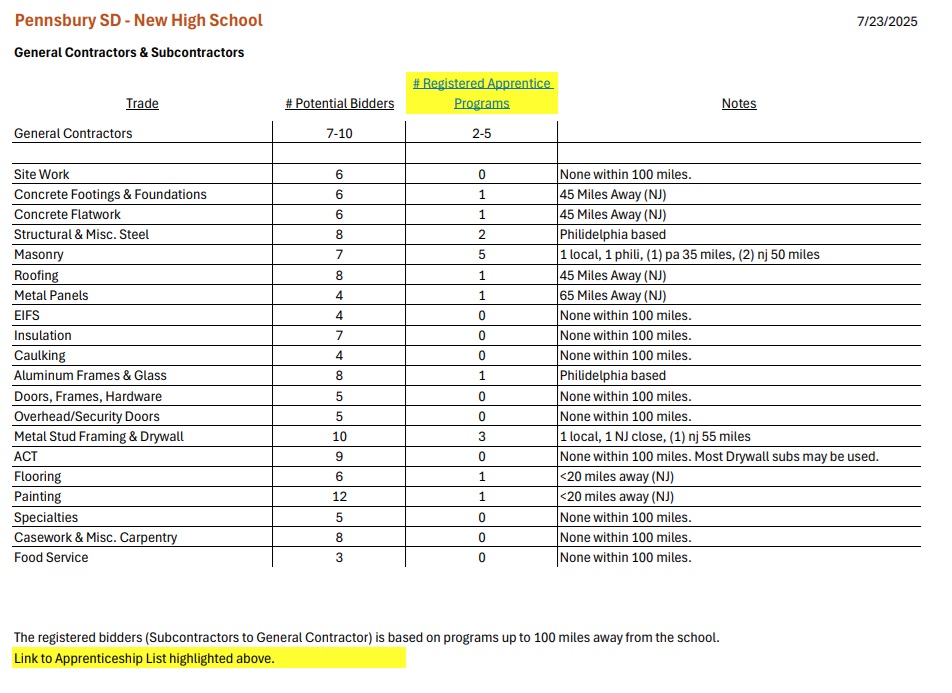
Anyone who listened to the full April 2024 discussion heard Jim Prokopiak confidently assure the community that the revised Responsible Contractor Policy would benefit Pennsbury across the board. Yet the early bidder assessment tells a very different story—one that directly contradicts nearly every claim Prokopiak made.
During that April 2024 meeting, Board Member Donna Ahrens raised concerns that the new requirements would exclude local contractors from the bidding process. Prokopiak dismissed those concerns outright. But the bidder assessment confirms Ahrens was exactly right: only two local companies met the new criteria to submit bids.
Even more troubling is the near-total absence of vendors who satisfy the 70% apprenticeship threshold that Prokopiak and Jeannie Delwiche insisted was a baseline standard. Of the 21 project line items reviewed, 10 failed to produce a single qualified bidder under the new policy. Another 7 line items yielded just one eligible contractor—effectively creating no-bid scenarios. Only 4 line items identified multiple vendors who met the Responsible Contractor Policy requirements.
This assessment not only validates the warnings voiced during the April 2024 debate—it exposes the policy’s immediate and measurable damage to competitive bidding and project viability.
What Is Pennsbury Doing About This Problem?
This really quick answer….NOTHING!!!!
At the August 7, 2025 School Board meeting, the agenda item addressing the Responsible Contractor Policy was quietly tabled without discussion—despite the sudden emergence of the Registered Bidder Assessment, which raised serious concerns. The matter was deferred to the Policy Committee.
One week later, on August 14, the Policy Committee convened. Yet again, no substantive discussion took place on the policy, even after a pointed public comment from Lower Makefield resident Robert Abrams opened the meeting. Following a 40-minute Executive Session, Committee Chair Jeannine Delwiche tabled the issue once more, this time blaming a vendor for relying on an “incomplete database”—a new excuse added to the growing list of deflections.
Audio Clip (begins at 40:00): https://drive.google.com/file/d/1dcQ0XJw8NIpksYv20a-0jVC3OIuWRR8e/view
The real question is: how could such a fundamental error surface so late in the process, with the Act 34 Hearing just two weeks away—a milestone where every detail of the project is supposed to be finalized and ready for public scrutiny?
Whether the liberal majority on the Pennsbury School Board will finally acknowledge the policy’s failure or continue pushing forward with a framework that benefits labor unions at the expense of open competition remains to be seen.
The post Pennsbury HS Building Project Hits ANOTHER Major Roadblock first appeared on Pennsbury411.
]]>The post Pennsbury High School Project Hits Speed Bump first appeared on Pennsbury411.
]]>Falls Township Tentative Vote Turns Into Repeat Feedback Session
The liberal media has had a field day unpacking the July 22, 2025 debacle. The Falls Township Planning Commission came prepared to scrutinize the Pennsbury proposal—only to be told by district reps that they weren’t seeking a vote, just feedback. And the plan? Virtually identical to the one they pitched months ago.
You can read the news story from Levittown Now for full details of the meeting and that calamity that occurred:
Planning Commission Chair John Haney clarified that the presentation was merely an overview—not a formal submission requiring a vote. Odd, considering Falls Township had already sent Pennsbury a memo outlining the necessary corrections for approval. “This is basically sketch plan version two. You don’t want to vote tonight, because it is hard for me to vote on anything with the amount of items that are missing,” Haney remarked. Despite receiving a detailed review letter from the township engineer back on June 17, Pennsbury apparently took a pass on fixing the errors. Sketch Plan v2.0? More like Copy-Paste v1.1.
And just when you thought the planning was confined to one township, it turns out part of the proposed site actually falls within Bristol Township. Pennsbury now says they’ll coordinate with Bristol’s planning commission—eventually. Because what’s one more jurisdiction when you’re already seem to be winging it?
Stormwater Drainage Becomes A Major Concern
If you live in Falls Township, you know the drill: when the rain pours, the stormwater struggles to keep up. It’s a familiar headache for many, especially those in the Pennsbury neighborhood. Longtime residents still remember the flooding back in the late 1960s that led to the creation of Lake Caroline and its dam at Hood Boulevard and Oxford Valley Road—just a half mile from the site of a new proposed development.
That history isn’t lost on planners or those that live downstream in Bristol Township. Stormwater management is a major focus of the Pennsbury HS project, with a system designed to handle runoff and reduce flood risk. The plan includes five above-ground detention basins and six underground ones, plus two more underground basins added specifically to meet Falls Township’s stormwater ordinance. Given the lack of proper documentation from Pennsbury, there are question marks as to whether or not their plans will be sufficient.
It’s a layered approach aimed at keeping water where it belongs—and keeping the neighborhood dry when the skies open up. But for anyone that attended the prom parade after the torrential downpour, they may still be searching for their sneakers if they made the decision to walk across the property that is the planned construction site area.
What Was In The Letter From Falls Township Engineer?
A letter from Jones Engineering Associates, the contracted engineering firm for Falls Township, was submitted to Pennsbury and signed by Township Engineer Joseph Jones on June 17, 2025. Jones detailed a litany of mistakes and lacking information in Pennsbury’s Land Development Application, totaling 19 pages in feedback.
The preliminary/final land development plans for the Pennsbury High School redevelopment raise several critical issues related to zoning compliance, stormwater management, traffic impact, and site design. The Township Engineer notes that the proposed building heights, accessory uses, and buffer zones require clarification and verification to meet zoning ordinance standards. There are also concerns about the adequacy of landscaping, screening, and architectural elevations—particularly around bus maintenance facilities and refuse collection areas—to ensure aesthetic compatibility and compliance with township regulations.
Stormwater management is a central focus, with the review identifying discrepancies in runoff calculations, basin designs, and emergency spillway provisions. The engineer emphasizes the need for revised grading and drainage plans to prevent increased runoff into adjacent residential areas, especially along Hanford Road and S. Queen Anne Drive. Additionally, the document calls for detailed construction phasing plans to ensure that stormwater systems remain functional throughout the buildout and that pedestrian safety and school operations are maintained.
Traffic and access-related concerns are also prominent. The review calls for a comprehensive traffic impact study to assess changes in student population, vehicle flow, and pedestrian routes. It highlights potential conflicts in internal circulation, driveway access, and intersection design—particularly near Hanford Road and Village Turn. Coordination with the Fire Marshal and Traffic Engineer is required to address emergency access and fire protection needs. Overall, the document underscores the need for more detailed documentation, revised plans, and multiple permits and agreements to ensure the project meets all township standards and mitigates potential impacts on the surrounding community.
Trust Us — Even If We Forgot the Details
With a $270 million price tag dangling from this redevelopment like a golden tassel, you’d think the Pennsbury School District might have triple-checked their homework. Instead, they turned in a submission riddled with missing calculations, zoning missteps, vague traffic plans, and stormwater designs that seem to defy gravity—and not in a good way. From forgetting to label accessory buildings to proposing runoff that could flood neighboring streets, it’s clear the district’s grasp of “final” plans is about as firm as a wet blueprint.
If this is the level of precision we’re getting before a single shovel hits the ground, it’s fair to ask: what happens when the real money starts flowing? Trusting a $270 million build to a team that can’t distinguish between a buffer zone and a bus garage feels less like progress and more like a very expensive gamble. Falls Township residents deserve better than a plan that reads like a first draft—and a school district that treats oversight like an elective.
The post Pennsbury High School Project Hits Speed Bump first appeared on Pennsbury411.
]]>The post Pennsbury School Board Candidate Andrew Dell Alleges Election Interference first appeared on Pennsbury411.
]]>
Public Comment Allegations Regarding Election Interference
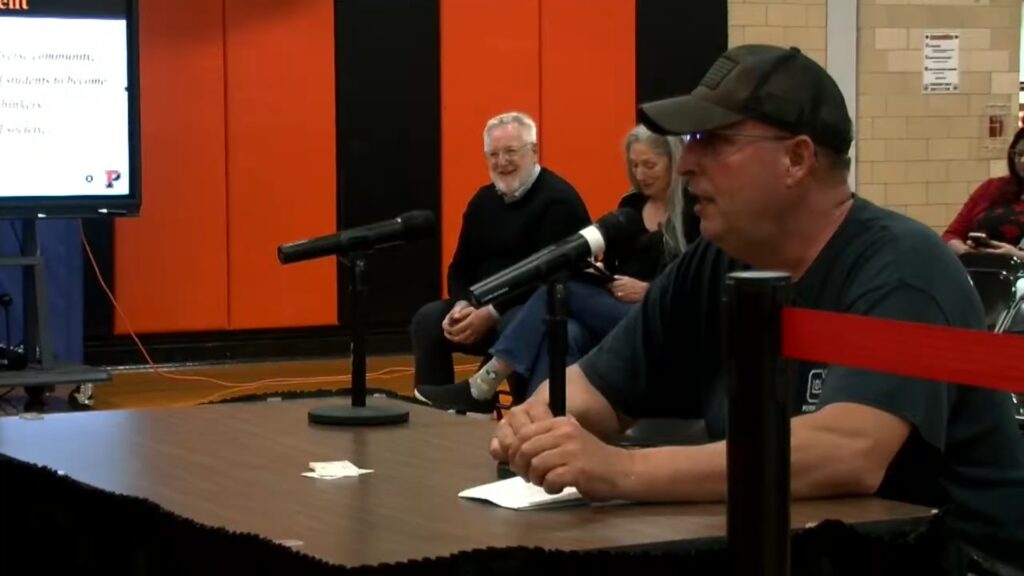
The second speaker at the public meeting was Andrew Dell, a candidate for the Pennsbury School Board. A regular attendee of Pennsbury Board meetings, Dell has consistently voiced concerns about declining academic performance, misplaced priorities on social issues, and financial mismanagement. During the most recent Board meeting, he again raised alarm over the estimated project costs for the planned PHS building, arguing that they are significantly understated. He also questioned the Board on why a referendum was not initiated.
Dell, after discussing key points about the PHS building project, shifted his focus to personal attacks against him on social media. These posts, originating from left-wing activist groups such as Indivisible Bucks County—a local chapter of the Indivisible Project—highlight the intensity of political discourse. While this organization has led protests nationwide, some demonstrations have reportedly escalated into violence, including incidents at Tesla dealerships. In the video below, Dell presents his public remarks and outlines his allegations of political interference in detail.
Who Is Michael Celec?
Michael Celec, a resident of Fairless Hills and the spouse of School Board Member Jeannine Delwiche, has become a frequent attendee of School Board meetings since Delwiche’s election. Celec manages a YouTube channel primarily dedicated to editing and posting videos that often portray private citizens attending Pennsbury public meetings. Many of these videos have been criticized publicly for being taken out of context. Additionally, the content includes footage from Pennsbury security cameras capturing incidents involving attendees who hold differing opinions from the Board, some of which Celec has personally been involved in as documented on his YouTube channel.
Based on publicly available property records, Celec and Delwiche became residents of Falls Township in 2017. Celec’s LinkedIn account shows that he is currently employed as a Library Assistant at Bucks County Community College since 2016. Celec also currently serves as the Executive Director of the Bucks County Audubon Society since January 2023. Form 990s were last filed with the IRS for the Bucks County Audubon Society on April 7, 2024 for Fiscal Year ending June 2023. Historically, the executive director received $85K in annual compensation with a substantial benefits package.

Celec, alongside his spouse Delwiche, have been very active members of Democratic-leaning political groups in Bucks Couty. Utilizing the Wayback Machine, Celec previously served as Deputy Chair of Communications for the Falls Township Democratic Party. Additionally, Delwiche and Celec were announced as new NAACP Bucks County Branch Executive Officers, a group that has routinely brought non-resident activists to Pennsbury School Board meeting.

Pennsbury Has History Political Misconduct
We saw first hand a few months ago the viciousness of some School Board members related to politics when Board Members was attacked over multiple meetings for daring to take a middle ground position around political symbols such as Gay Pride Flags in classrooms. This blog previously reported on the 2021 election misconduct that included cease and desist orders against Republican candidates, federal violations of civil rights during public meetings of community members and a SLAAP lawsuit against Republican candidates brought by Board Members Jeanine Delwiche, Linda Palsky and Joanne Steere after a direct mail campaign made unflattering correlations. SLAAP lawsuits have since become illegal in Pennsylvania due to the abuses by those that file them.

At the recent Pennsbury Board meeting, where Andrew Dell presented his allegations, a Falls Township resident who recognizes as “Watermelon Man” during public comment, revisited one of the community’s most controversial political moments from the 2021 election: the “Peace Vigil” held at the Garden of Reflection. At this event, Pennsbury School Board members and candidates alleged death threats whose severity were later disproven during a First Amendment injunction hearing. The Federal court ultimately determined that Pennsbury officials had violated the civil rights of four community members at the hearing.
In addition to revisiting the Gardens of Reflection event, “Watermelon Man” also exposed politically motivated attacks and false allegations against him after attending a recent committee meeting. Pennsbury is believed to have contacted Falls Township police related to a complaint based solely on hearsay, as Right to Know requests revealed that the district had no concrete evidence to support its claims. Important note, “Watermelon Man” is the spouse of Falls Township Supervisor candidate Jennifer Metzger. Both are frequent attendees of Pennsbury School Board meetings and have been vocal critics of the planned PHS building, which is set to be constructed just 30 to 40 yards from their home on Hood Boulevard.
The video of “Watermelon Man” providing public comment related to the false allegation against him and his recounting of the Gardens of Reflection political event can be viewed below.
The post Pennsbury School Board Candidate Andrew Dell Alleges Election Interference first appeared on Pennsbury411.
]]>The post EXCLUSIVE: RTK Request Uncovers Labor Union Incident on Pennsbury HS Building Site first appeared on Pennsbury411.
]]>Operating Engineers Union Engages Geotechnical Engineers
David Blackmore & Associates (DBA) were commissioned to conduct a geotechnical survey of the Pennsbury property slated for construction. Their work involved drilling 39 boreholes, each between 20-30 feet deep, to assess water presence, determine soil composition, and identify underlying rock formations. The survey took place in early March, with the final report made public on May 8, 2025, following concerns raised about potential PA Sunshine Law violations during the May Facilities Committee Meeting.
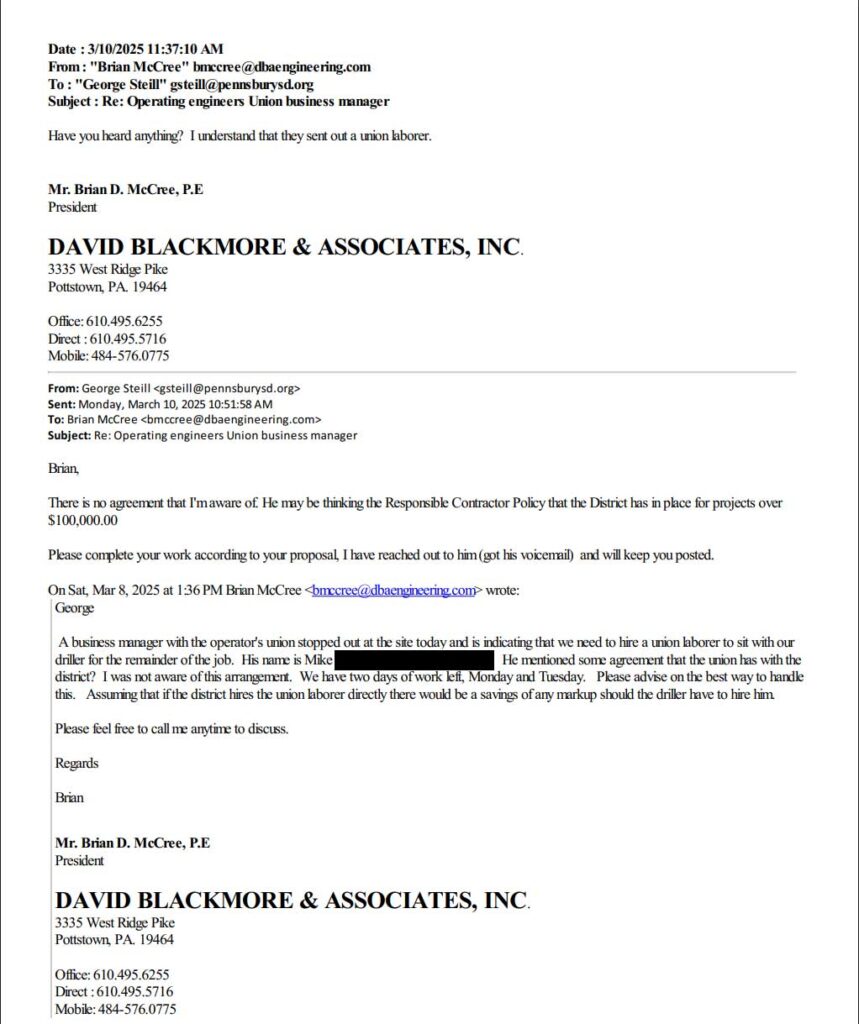
In response to a Right-to-Know (RTK) request by Lower Makefield resident Robert Abrams, email exchanges between DBA and Pennsbury officials revealed that labor unions had approached DBA employees at the site. A business manager named Mike confronted a DBA employee, insisting that a union laborer must be hired to accompany the driller, citing an alleged “Agreement” with Pennsbury. However, Director of Facilities George Steill confirmed that no such agreement exists or applies to this project. The email thread concluded with DBA President Brian McCree notifying Steill that the union had, indeed, sent their laborer to the site.
What Is The “Agreement” Noted In The Email?
In his email response, George Steill clarifies that no formal “Agreement” exists, suggesting to DBA that there may be some confusion. He further explains that the misunderstanding likely stems from the Responsible Contractor Policy. This policy, established by the Pennsbury School District, mandates that companies providing construction services employ a specific percentage of certified laborers. It has been a longstanding point of contention among Pennsbury School Board members, with the board divided on whether to enforce higher percentage requirements. The key question remains: why does the union believe an “Agreement” is in place?
The video below captures a heated debate from the April 18, 2024, Action Board meeting, where Pennsbury Board Members clashed over proposed changes to the Responsible Contractor Policy. Jim Prokopiak spearheaded efforts to update the policy, advocating for restrictions on non-union laborers, while Chip Taylor pushed to preserve the existing framework, which grants the Board discretionary control over contractor selection. This video begins precisely at the moment when the discussion on policy updates took place.
At the time of this meeting, Jim Prokopiak had already won the special election for State Representative of the 140th Legislative District and was officially sworn into office in Harrisburg on March 18, 2024. However, despite assuming his seat in the state legislature, Prokopiak chose not to resign from the Board and remained an active member for two additional meetings. One of those meetings—the April 18, 2024, Action Board meeting—centered on a proposed policy update that would significantly benefit labor union members. In the video below, captured from the same meeting, the Public Comment session features a strong presence of union laborers, including members of Operating Engineers Local 542 that came forward to lodge the support publicly.

Why Would Unions Believe They Have An “Agreement”?
It is a head scratcher as to why the labor unions would believe that a policy would be considered a binding agreement with Pennsbury. What could have led to this misunderstanding? Only those behind the scenes truly know the answers and we will likely never be able to confirm the reasons behind why this misunderstanding really occurred.
Approximately a year ago, following the vote to update the Responsible Contractor Policy, confidential leaks regarding a fundraiser hosted by Jim Prokopiak surfaced among various Pennsbury community members. Contributors to PSD411 were urged to investigate campaign donations tied to an event held in January 2024. Upon reviewing Prokopiak’s campaign finance filings, the event was identified as taking place on January 10, 2024 at what appears to have been the 54 Bar & Grill based on reported expenditures, during which nearly $80,000 in donations were received, predominantly from labor unions.
Within Prokopiak’s campaign finance filings, the interesting details begin to surface on Page 17, Part C, Contributions Received From Political Committees. On January 10th we find the following contributions made to Prokopiak:
- IBEW PAC — $20,000
- PLUMBERS LOCAL UNION 690 — $10,000
- AFSCME COUNCIL 13 — $2,500
- WASTE MANAGEMENT — $500
- FRIENDS OF ERIN MULLEN — $1,000
- SANTARSIERO FOR STATE SENATE — $5,000
- OPERATING ENGINEERS LOCAL 542 — $2,500
- ROOFERS LOCAL 30 — $1,000
- FRIENDS OF BOB HARVIE — $500
- STEAMFITTERS LOCAL UNION 420 — $2,500
- IUPAT DC21 — $2,500
- OPERATIVE PLASTERERS AND CEMENT MASONS LOCAL 592 — $500
- OBERMAYER REBMANN MAXWELL & HIPPEL LLP — $750
- FRIENDS OF TIM BRENNAN — $500
More campaign donations from PACs came just days after the fundraising event:
- SPRINKLERFITTERS LOCAL UNION 692 — $2,500
- MECHANICAL SERVICE CONTRACTORS ASSOC. — $500
- 1776 PAC — $2,500
- SHEET METAL WORKERS UNION LOCAL 19 — $5,000
- FALLS TOWNSHIP DEMOCRATIC PARTY — $1,000
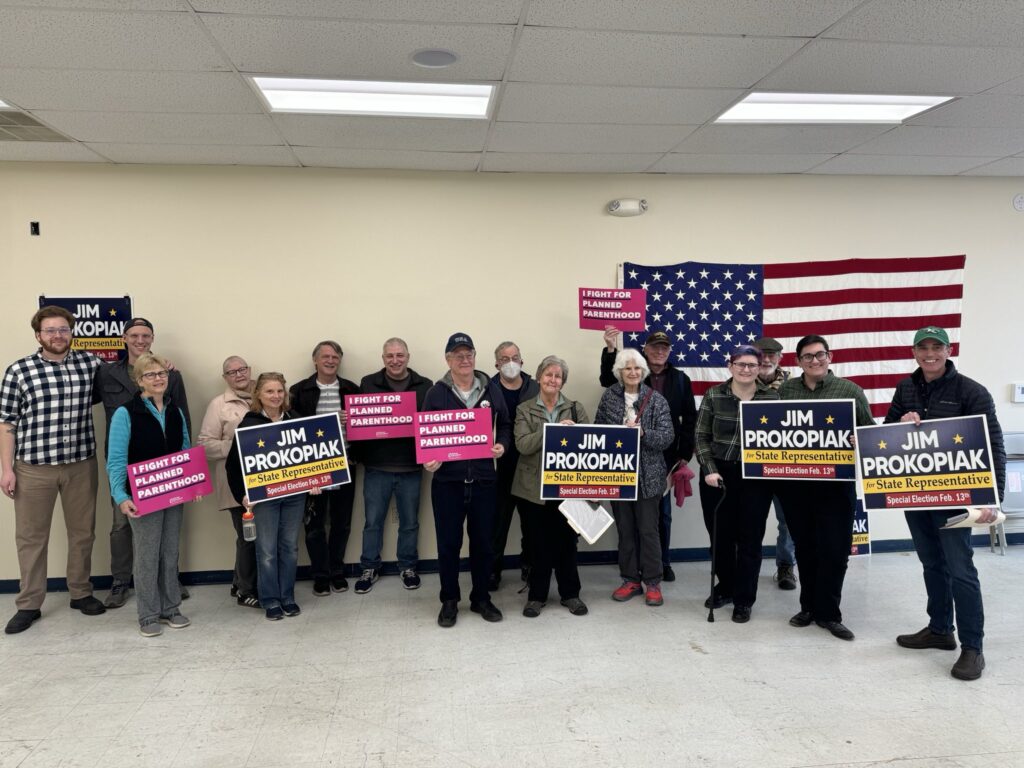
As previously noted, only those behind the scenes will understand the reasons behind the “Agreement” confusion. Primary election day is Tuesday, March 20, 2025. Many of these union representatives are typically at the polls in Falls Township, so feel free to ask them as you go in to vote about this confusion. Political leaders Steve Santarsiero, Bob Harvie, Jim Prokopiak and Erin Mullen should be accessible to the public to answer questions as well, along with Pennsbury School Board members..
The post EXCLUSIVE: RTK Request Uncovers Labor Union Incident on Pennsbury HS Building Site first appeared on Pennsbury411.
]]>The post PHS Building Project Geotechnical Report Filled With Holes, Raising Concerns first appeared on Pennsbury411.
]]>During the meeting, Dr. Tom Smith was recorded stating that no one had received the reports. However, this claim was contradicted by vendor KCBA, who had reviewed the documents and even included a slide about them in their presentation. The slide was ultimately skipped, seemingly due to the objections raised. Public attendees noted that none of the Pennsbury School Board members present which also included Joanne Steere, Chip Taylor, and Donna Petrecco, appeared aware of the report’s contents, nor did they pose any relevant questions during the meeting.
Geotechnical Report Is Revealed
The Geotechnical Report was released to the public through a Right to Know (RTK) request on May 8, 2025, exactly one week after the Facilities Committee meeting and the maximum delay permitted under Pennsylvania law. During the Finance Committee meeting held that same day of May 8th, a school board member’s spouse openly disclosed and it was overheard by multiple meeting attendees that Pennsbury School Board Members had received copies of the report prior to its public release and had been “pouring over” the report. This revelation confirmed suspicions that Pennsbury had deliberately postponed access for as long as legally possible. The report itself, as indicated on its first page, was completed on April 10, 2025.
Below is the complete, unedited report detailing the significant presence of water and the questionable underlying rock formations on the desired land. These are issues Pennsbury officials have been aware of since August 2023. These concerns were first identified in a Geotechnical Report conducted at the time by Earth Engineering Incorporated. Much like the latest report, the previous finding which raised serious questions about the land’s viability were downplayed by Pennsbury officials, with minimal discussion of their implications.
What Does The New Geotechnical Report Say?
The latest report from David Blackmore & Associates (DBA) largely aligns with the findings from Earth Engineering Incorporated (EEI) two years ago, offering little contradiction to the earlier assessment. The report reaffirms previous concerns about the site’s heavy water saturation, the presence of silt and sand and the nature of the underlying metamorphic schist rock formations. The primary differences in this new study compared to the earlier report lie in methodology: the boring holes were drilled a few feet deeper, and the number of borings drilled was quadrupled across the planned construction zone.
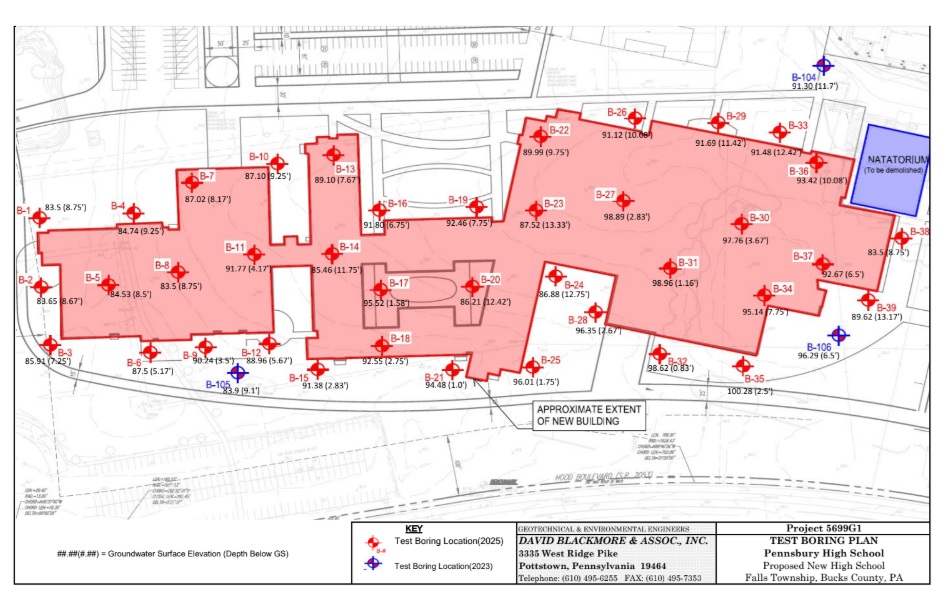
Although the DBA study was conducted during a period of severe drought alerts, it still found water at remarkably shallow depths throughout the planned construction site. Page 5 of the report offers detailed insights into the water level conditions recorded. Notably, the water table readings in this study reflected even more concerning metrics than those documented in EEI’s previous report, despite the extreme drought conditions at the time of the more recent survey.
Groundwater was encountered in each of test borings completed. The groundwater levels encountered range from 0.83 feet to 13.17 feet below the existing grade, corresponding to surface elevations ranging from 83.47 and 100.28 feet. The variation is groundwater depth and elevation are related to perched groundwater conditions associated with the interbedded sand and silt and clayey silt layers encountered onsite. NOTE: Groundwater was encountered approximately 2.5 to 4.5 feet above the planned pool bottom elevation of 92.5 feet. See Borings B36B, B37, B38 and B39 which are in the vicinity of the pool.
REPORT OF GEOTECHNICAL EXPLORATION | DAVID BLACKMORE & ASSOCIATES | APRIL 10, 2025
Page 10 of the report outlines the subsurface conditions and rock formations found during the study. DBA identified various types of metamorphic schist, whose suitability for building foundations depends on rock density. The report classifies these formations into Stratum IF, Stratum II, Stratum III, and Bedrock. Of these, Bedrock—considered the most stable foundation material—was only present on the western edge of the planned construction site. Stratum II emerged as the most prevalent type of schist, appearing in all drilled boring holes.
Stratum II: 2.0’ to 21.33’ thick; Interbedded alluvial deposits including alternating layers of orange-brown, brown, and gray mottled fine sand and silt; fine to medium sand with some silt; micaceous fine sand and silt with some rock fragments; and brown and gray clayey silt. This stratum is a primarily moderately stiff to dense deposit with SPR values ranging from 6 to 34 blows per foot. However, localized low SPT values ranging from 2 to 3B/F were encountered (See boring B16 and B17) at depth within this stratum within the groundwater vadose zone. This condition is attributed to pore pressure variations in the borehole and is not considered to be indicative of a widespread compressible soil layer. This stratum was encountered in each of the borings completed.
REPORT OF GEOTECHNICAL EXPLORATION | DAVID BLACKMORE & ASSOCIATES | APRIL 10, 2025
What Warranties Are Presented In The Report?
This is where the Geotechnical Report gets a bit sticky. While Section 9 referred to as “Limitations” found on Page 20 of the reports offers a pause for a concern. It is not uncommon for the lack of warranties to exist in such an engineering report given you never know what might be underlying that isn’t determined from the boring holes drilled. In a project of this magnitude, any issues uncovered after excavation begins could result in massive change orders that could explode the cost of the project.
LIMITATIONS
REPORT OF GEOTECHNICAL EXPLORATION | DAVID BLACKMORE & ASSOCIATES | APRIL 10, 2025
Services performed by DBA, including the Geotechnical Exploration, report, and any subsequent construction monitoring have been or will be conducted in a manner consistent with that level of care and skill ordinarily exercised by members of the profession currently practicing in the same locality under similar conditions. No other warranty or guarantee is indicated or intended in this report or any opinion, document or otherwise stated.
The recommendations included herein are based on the conditions encountered by the test borings performed at the subject site. It is noted that, although soil quality has been inferred from the interpolation of the site sampling data, subsurface conditions beyond the test borings are, in fact, unknown. As a result, these recommendations may require modifications based on the conditions encountered and exposed during construction excavation. Should any conditions encountered during construction differ from those described in the report, this office should be notified immediately in order to review and possibly modify the recommendations included in this report.
At the Facilities Committee meeting on May 1, 2025, officials assured attendees that the land was suitable for construction based on the findings in the Geotechnical Report. However, in reality, numerous obstacles and significant change orders are likely to arise—particularly given the history of past Pennsbury School Board construction projects. These modifications could easily surpass eight figures, adding to the financial burden on the Pennsbury community beyond the already contentious $270 million cost estimate, which is 25% to 30% lower than comparable school building projects in nearby communities.
What Project Changes Can Be Expected?
According to the report’s findings and widely available research, metamorphic schist is not an ideal foundation material for construction. Its density can vary, and it has a tendency to fracture horizontally under significant weight pressure. Additionally, in waterlogged conditions—such as those identified in the report—schist requires extensive water management and pumping solutions to mitigate stability concerns. Furthermore, research suggests that a floating slab foundation is generally not advisable in such conditions. Instead, deep footings or pilings are recommended to anchor the foundation to the densest underlying rock for optimal structural support.
The report highlights the extensive excavation required, which appears to exceed the initial plans outlined earlier in the process. According to the DBA report, the construction footprint spans 295,064 square feet, with excavation reaching 20 feet deep, totaling 248,148 cubic yards of material to be removed. This volume translates to an estimated 12,407 truckloads needed for removal. Given the current landfill rate of $87 per ton in the Philadelphia area, disposal costs are projected to reach approximately $27 million. Notably, this expense does not appear to be accounted for in SiteLogiQ’s most recent estimate presented at the April 3, 2025 Facilities Committee meeting.
When will the Pennsbury School Board come clean and admit that this building cannot be constructed at the prices they continue to float?
The post PHS Building Project Geotechnical Report Filled With Holes, Raising Concerns first appeared on Pennsbury411.
]]>